
Simplified or Standard Tax Regime? Egypt Startup Guide 2026 — Taxera
— Ahmed Ismail
From Law to Decision: A Startup's Guide to Choosing Its Tax Regime in 2026
Nov 17, 2026 · @Ahmed Ismail
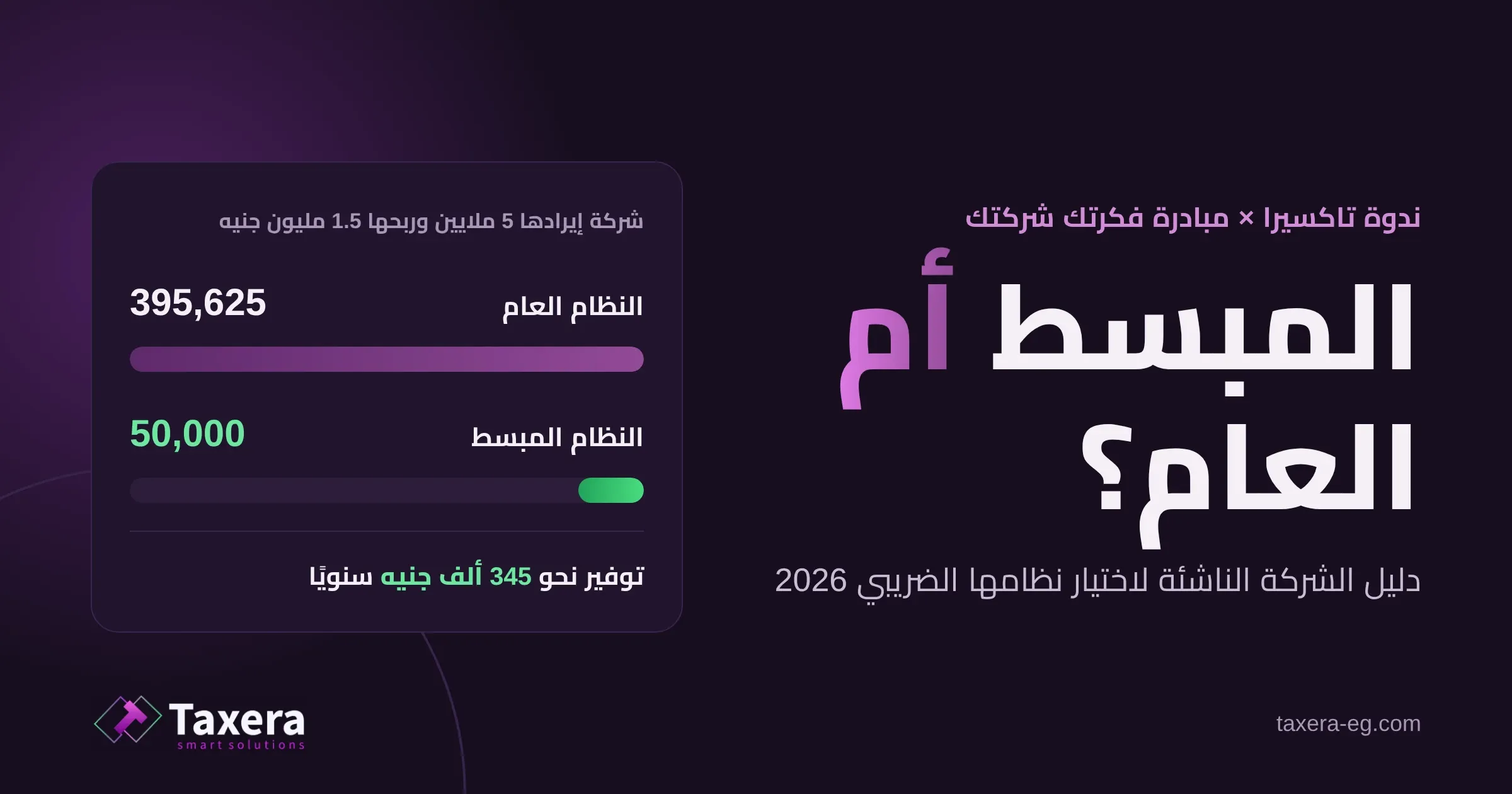
A company with EGP 5 million in revenue and EGP 1.5 million in net profit distributes half of its profit to the partners. Under Egypt's standard tax regime it pays EGP 395,625 a year; under the simplified regime, just EGP 50,000. Same company, same numbers. The difference is a single decision.
This article distills the seminar "From Law to Decision: Compliance That Opens Opportunities," presented by Taxera in partnership with the Fekretak Sherketak initiative. It covers what a startup founder needs to make the tax decision with confidence: which regime fits, what changed in 2026, and how to stay compliant without surprises.
The Simplified Regime: Tax on Revenue, Not Profit
Law No. 6 of 2025 gives businesses with annual turnover of up to EGP 20 million a simplified regime: tax at a small percentage of total turnover, instead of 22.5% of net profit under the standard regime. It covers both registered and unregistered businesses, across commercial, industrial and professional activities.
Annual turnover | Tax rate |
|---|---|
Below EGP 500,000 | 0.4% |
EGP 500,000 to below 2 million | 0.5% |
EGP 2 million to below 3 million | 0.75% |
EGP 3 million to below 10 million | 1% |
EGP 10 million to 20 million | 1.5% |
The rate is not progressive: a business with EGP 5 million in turnover pays 1% on the full amount, or EGP 50,000 for the year.
Eligibility conditions
Joining the e-invoice and e-receipt systems, and actually issuing through them.
Submitting the joining application electronically on Form 1/10, and filing returns on time.
You cannot leave the regime for five years, so the decision needs to be calculated in advance.
Excluded: professional consulting where 90% of turnover comes from one or two parties, and splitting an activity without an economic rationale.
Key benefits
No tax is withheld from your receipts and no advance payments are due, though you must still withhold from your suppliers.
Dividends are tax-exempt.
Exemption from stamp duty, development fees and notarization fees on incorporation, financing and mortgage contracts, plus exemption of gains on selling fixed assets and machinery.
Quarterly VAT returns, payroll tax through the annual settlement return only, and simplified books.
Tax audit deferred for five years from the joining application. Deferred, not cancelled, so sound documentation is essential from day one.
Who Should Choose the Simplified Regime?
The decision comes down to one question: what is your net profit as a percentage of sales? The standard regime taxes your profit; the simplified regime taxes your revenue, even in a loss-making year.
Services and software companies: the simplified regime is usually the best choice. A company with EGP 5 million in revenue and a 30% margin pays EGP 337,500 under the standard regime and EGP 50,000 under the simplified one, a saving of about 85%.
Trading companies: simplified is the natural choice unless net margin falls below roughly 7%. EGP 8 million in revenue at a 10% margin means EGP 180,000 under the standard regime versus EGP 80,000 under the simplified one.
Industrial companies: need analysis before deciding. A factory with EGP 2.5 million in revenue that made a loss in its founding year pays nothing under the standard regime and carries the loss forward, but pays EGP 18,750 under the simplified regime despite the loss.
The rule of thumb: breakeven in the top bracket is 1.5% ÷ 22.5% ≈ 6.7%. If your net profit exceeds 7% of sales, the simplified regime is cheaper in every bracket. And if you plan to distribute profits, the balance tips further toward it, since dividends are exempt there but taxed at 10% under the standard regime.
A full example
The company we started with: EGP 5 million in revenue, EGP 1.5 million in profit, half of it distributed.
Standard regime | Simplified regime | |
|---|---|---|
Corporate tax | 22.5% × 1.5 million = 337,500 | 1% × 5 million = 50,000 |
Dividend tax | 10% × 581,250 = 58,125 | Exempt |
Total (EGP) | 395,625 | 50,000 |
The saving is about EGP 345,000 a year. This is a preliminary calculation; the final decision requires a review of each company's case.
Founder Salary or Dividends?
Under the simplified regime, a founder's salary does not reduce the company's tax, because the tax is calculated on turnover, not profit. Dividends, on the other hand, are exempt under Article 9.
Example: a founder takes EGP 30,000 a month, or 360,000 a year. Paid as salary, payroll tax comes to about EGP 61,000 a year before social insurance. Paid as dividends under the simplified regime, the tax is zero.
The right balance: a reasonable, insured salary for a founder who works in the company, with the rest paid as dividends from actual profits by a partners' resolution. Under the standard regime the math is different, since salary is deductible from profit while dividends are taxed at 10%.
When Your Company Grows
Startups plan to grow, so you need to know what happens when you pass the EGP 20 million threshold:
An overrun of no more than 20% (up to EGP 24 million), once within the first five years: you stay in the simplified regime at 1.5%.
A larger or repeated overrun: eligibility ends from the following year, and you move to the standard regime with its full obligations.
A question founders ask often: investor money is capital, not revenue, so it does not count toward turnover. Our advice: proper accounts and financial statements from day one. Investors and banks will ask for them before the Tax Authority does.
What's New in 2026
A set of tax amendments was published in the Official Gazette on 28 July 2026, followed by Minister of Finance Decree No. 639 of 2026. The most relevant for startups:
A temporary tax card for eight months to complete incorporation and licensing. Its dues are paid after it expires, and it cannot be used to issue e-invoices (Law 150).
Regular books for every taxpayer, with simplified books for Law 6 businesses (Law 150).
VAT credit refunds after more than three months for Law 6 businesses, and after more than four consecutive periods for others (Law 149 and Decree 639).
Suspension of VAT on machinery and production lines for factories for one year, extendable to three, converting into an exemption once used in production (Law 149 and Decree 639).
Bad debts become deductible 12 months after falling due, with serious collection efforts; debts of up to EGP 10,000 qualify under easier conditions (Law 151).
Real estate disposals are taxed at 2.5%, payable within 60 days, and the tax does not apply to transfers to parents, spouses and children (Law 151).
The solidarity (Takaful) contribution under the Universal Health Insurance Law is now a deductible cost (Law 151).
Tax dispute settlement is available until 31 December 2026 (Law 152).
Compliance: The Condition for Every Opportunity
Every facility above depends on being registered and compliant. Real compliance goes beyond filing on time to the accuracy of the figures you file: the Tax Authority automatically matches your return against your invoices and those of your customers and suppliers.
The e-invoice is the foundation
The revenue in your return must equal the total of your e-invoices.
No expense is deductible from profit, and no input VAT can be credited, without an e-invoice.
A supplier who does not issue e-invoices costs you twice: a disallowed expense, and VAT you can neither credit nor recover.
It is also a core condition for joining the simplified regime.
Key deadlines
Return | Standard regime | Simplified regime |
|---|---|---|
VAT | Monthly, even with no sales | Quarterly |
Payroll tax | Monthly payment, quarterly return, settlement in January | Annual settlement only |
Withholding from suppliers (Form 41) | Quarterly | Quarterly; nothing is withheld from you |
Corporate income tax | Before 1 May for years ending in December | Form 20 by the same date |
Five mistakes we see every day
Revenue in the return is lower than the e-invoices. Fix: reconcile monthly before filing.
Input VAT credited on a paper invoice. Fix: file an amended return before the audit.
Personal expenses in the company's books. Fix: a separate company bank account.
No return filed because there were no sales. Fix: filing is mandatory, even as a nil return.
A customer withholds tax from you although you are under Law 6. Fix: notify them in writing with proof of your status.
The cost of delay is not small: a fine of EGP 3,000 to 50,000 if the delay does not exceed 60 days, and EGP 50,000 to 2 million beyond that, on top of the late-payment charge. And the manager who actually runs the company is personally liable for what they sign, so never sign a return you do not understand.
Your Company's First 90 Days
First two weeks: choose the legal form, obtain the commercial register and tax card, open a company bank account, and register on the e-invoice system.
By day 30: complete tax registration, decide between the simplified and standard regimes, and register every employee with social insurance within two weeks of joining.
By day 90: reconcile invoices, returns and accounts every month, make no payment to a supplier without an e-invoice, and set a clear policy for founder salary and dividends.
Conclusion
The law alone does not make the difference; the decision does. The simplified regime could save your company hundreds of thousands of pounds a year, but it binds you for five years and does not replace sound compliance. Calculate before you decide, and start right from day one.
At Taxera, we support startups from incorporation through tax audit, with more than 25 years of tax experience. If you would like us to work out which regime suits your company using your actual numbers, get in touch:
WhatsApp and phone: 01055333453 · 01055333151 (+20 from outside Egypt)
Website: taxera-eg.com
Branches: Alexandria and 6th of October
This article is for general awareness, based on laws published up to November 2026, and does not replace a review of each company's case.